


What is an internal communications intranet and how does it differ from a traditional one?
Think of an internal communications intranet as your company's own private social network and knowledge engine, designed around what your people need to do their jobs effectively, whether your employees are deskless, desk-based or mobile first.
It’s the complete opposite of a clunky, forgotten grey site of the past that are often viewed as chronological, digital filing cabinets. Modern internal communications intranets are dynamic, central hubs that focus entirely on the employee experience (EX), enabling personalised, two-way communication and knowledge sharing that powers your whole business. Here's a comparison of how an internal communications intranet compares to a traditional intranet:
| Feature | Traditional Intranet | Modern IC Intranet |
| Accessibility | Desktop/VPN only | Mobile-first / native app |
| Communication | Top-down (broadcast) | Two-way & lateral |
| Content | Can feel like a chronological, filing cabinet | Dynamic, sometimes with AI-personalised homepages |
| Search | Keyword-based (clunky) | AI-powered (semantic) |
The internal communication intranet challenges
The three primary challenges of an IC intranet are knowledge management issues, employee disconnection and fragmented tools. The job of an IC professional has changed with internal communications becoming an increasingly prominent business function, impacting employee engagement, culture, and connection.
-
Knowledge management issues: Staff waste hours searching through folders and emails for the right policy, leading to errors and frustration.
-
Employee disconnection: Employees in different locations, shifts, or even different departments feel disconnected and out of the loop.
-
Fragmented tools: Too many platforms (Slack, Teams, email, shared drives) mean multiple conversations happen in multiple places, and suddenly everything important gets lost... there are multiple versions of the same thing and everything becomes derailed when its processes should be seamless and simple.
What was once sending out emails that feel like broadcasts, internal comms is now built around improving culture, driving consistently high engagement, and making every employee feel seen and connected. The challenge? Getting your messages across a scattered, remote, and often digitally exhausted workforce.
Why a modern intranet is the backbone of internal comms (IC)
An intranet is something employees should want to use and so choosing a modern internal communications intranet really is a crucial strategic investment in your company’s employee engagement success.
Establishing a centralised single source of truth:
It’s amazing how easy life is when you access everything you need in one place. Think about it, you have everything you could ever need on your mobile phone, just a few clicks away…that’s why having one definitive place for accurate information has such an impact on employee experience.
When your intranet becomes that trusted source, you instantly reduce information overload and give your team the confidence that they are always working with the right information.
Streamlining the employee journey:
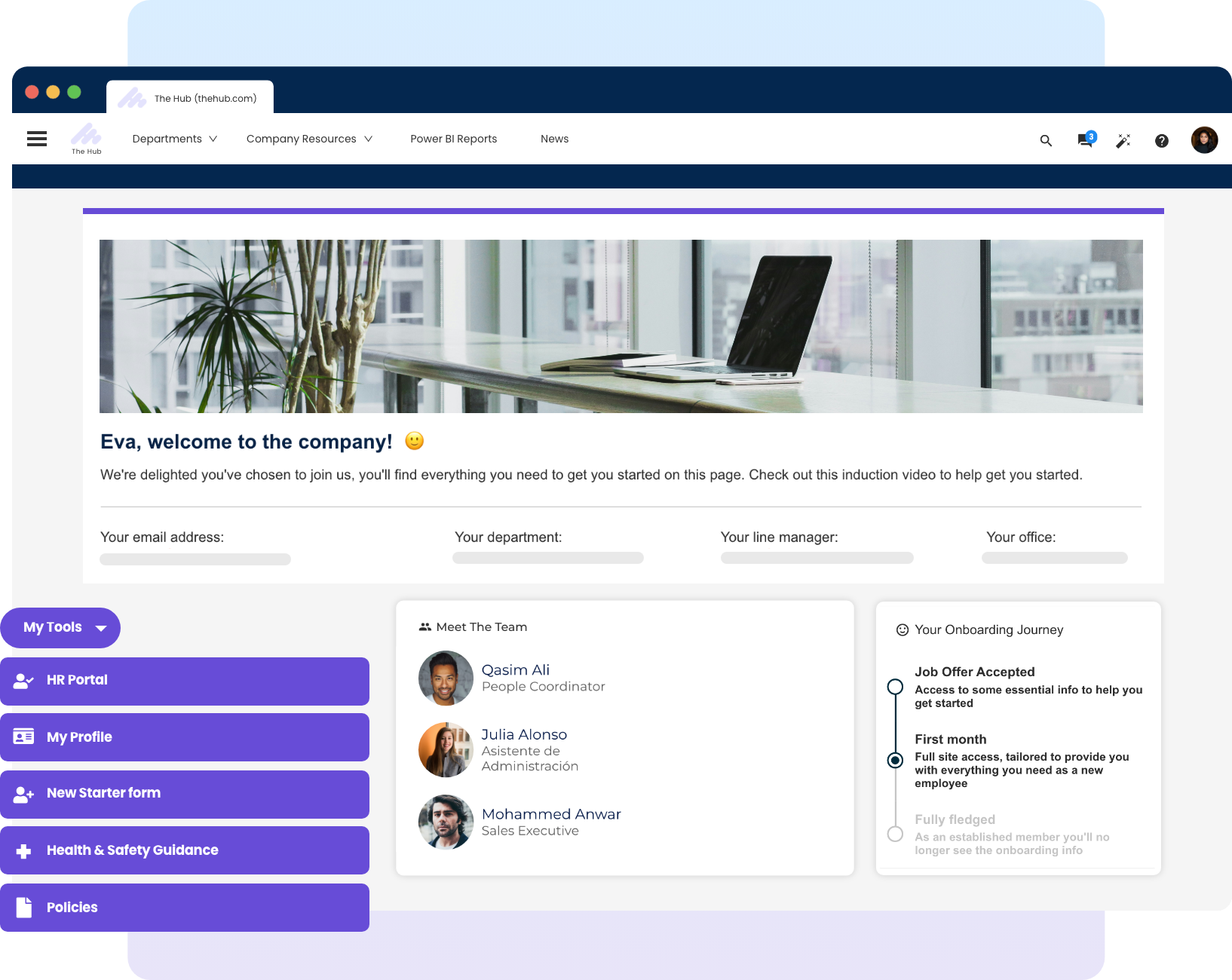
A central, organised hub smooths out internal communication flow and collaboration. For new starters, it makes onboarding processes so easy: they get instant access to everything they need, helping them feel like part of the team and giving them the ability to thrive in their role from day one.
Breaking down silos and fostering community:
Intranets help tear down the invisible walls between departments. By hosting project spaces, interest groups, and cross-functional forums, you actively break down silos and help your people connect over work-related topics, and hopefully help people form connections around hobbies and interests.
Accessibility and flexibility for the dispersed workforce:
Whether your people are on the factory floor, shop front, burger flipping station, working from home, or travelling...the intranet has to go where they go. Accessibility and flexibility mean your vital comms can be received via native mobile apps, ensuring you hard-to-reach employees can view communications and information anytime, anywhere.
The three flows of communication: top-down, bottom-up, and lateral
A modern internal communications intranet is uniquely positioned to handle all three essential communication flows, ensuring a healthy, balanced communication ecosystem:
-
Top-down (the broadcast): This is the classic flow of information from leadership to employees (e.g., strategy, policy, formal announcements). The intranet uses personalisation and targeting to ensure the right people receive the right corporate message.
-
Bottom-up (the feedback loop): Crucial for enabling employee voices to be heard via surveys, suggestion boxes, and comments, informing leadership decisions and building trust.
-
Lateral (peer-to-peer): Facilitated by community channels, social functionality, and forums, enabling project collaboration and informal sharing across teams.
Essential comms intranet features for internal communications success
Personalisation and targeting
If you send every message to everyone, people stop reading everything. You can be the person who ensures people only get the content they need, by using personalisation and targeting to deliver relevant news. Use intranet personas and push vs. pull targeting to ensure your finance team only sees finance news and your frontline staff only see critical updates.
Smplified CMS
Don't let clunky software slow you down. A simplified CMS empowers communicators across the business to create content quickly. Look for features like no-code creation, scheduling tools, and easy approval workflows.
Advanced search functionality

This is your platform's most important tool. A powerful, Google-esque search means people can find the answers they need instantly, building trust and saving everyone time.
Global capabilities and digital accessibility
For international companies, the intranet must be accessible for everyone. Multilingual support ensures every employee can engage fully in their native language. Furthermore, a modern intranet must prioritise digital accessibility (e.g., WCAG standards) to ensure an inclusive experience for all employees.
Integrating dynamic collaboration and real-time communication
Connect your people faster. The best intranets either integrate with your existing chat tools (like Teams) or offer their own capabilities for real-time communication, video, and instant messaging to handle those quick decisions and urgent issues.
Community and group sites
Give teams a digital home base! Community and group sites are the foundation for focused, ongoing communication, making it easy to create team-specific communications without cluttering the main feed.
Video and visual content tools
Views don't guarantee comprehension. Because visuals are processed faster than text, your intranet should make it easy for everyone to embed, host, and share video content for announcements, training, and insights into other teams experiences. We have 'Moments', a feature that allows employees to create their own TikTok style content. Sacha spoke about this in our latest webinar 'The frontline divide: the hidden cost of a disconnected workforce':
Social functionality, employee advocacy, and internal newsletters
A successful intranet allows people to seamlessly connect and collaborate with one another. Native social tools like liking, commenting, and @mentioning turns passive readers into active participants. Furthermore, modern internal communications intranet platforms support:
-
Employee advocacy: Enabling employees to easily share approved, positive company content to their personal social networks to boost recruiting and brand trust.
-
Internal newsletters: Using the intranet's CMS to create curated email digests of top stories, ensuring employees who prefer email don't miss key updates.
Spaces for wellbeing and mental health resources
Looking after your employees is essential for creating a great place to work where people feel valued and looked after. The intranet is the ideal private channel for distributing mental health resources, signposting employee assistance programmes (EAPs), and running sensitive, anonymous surveys that address stress and burnout and how to improve things in the workplace.
Gathering feedback
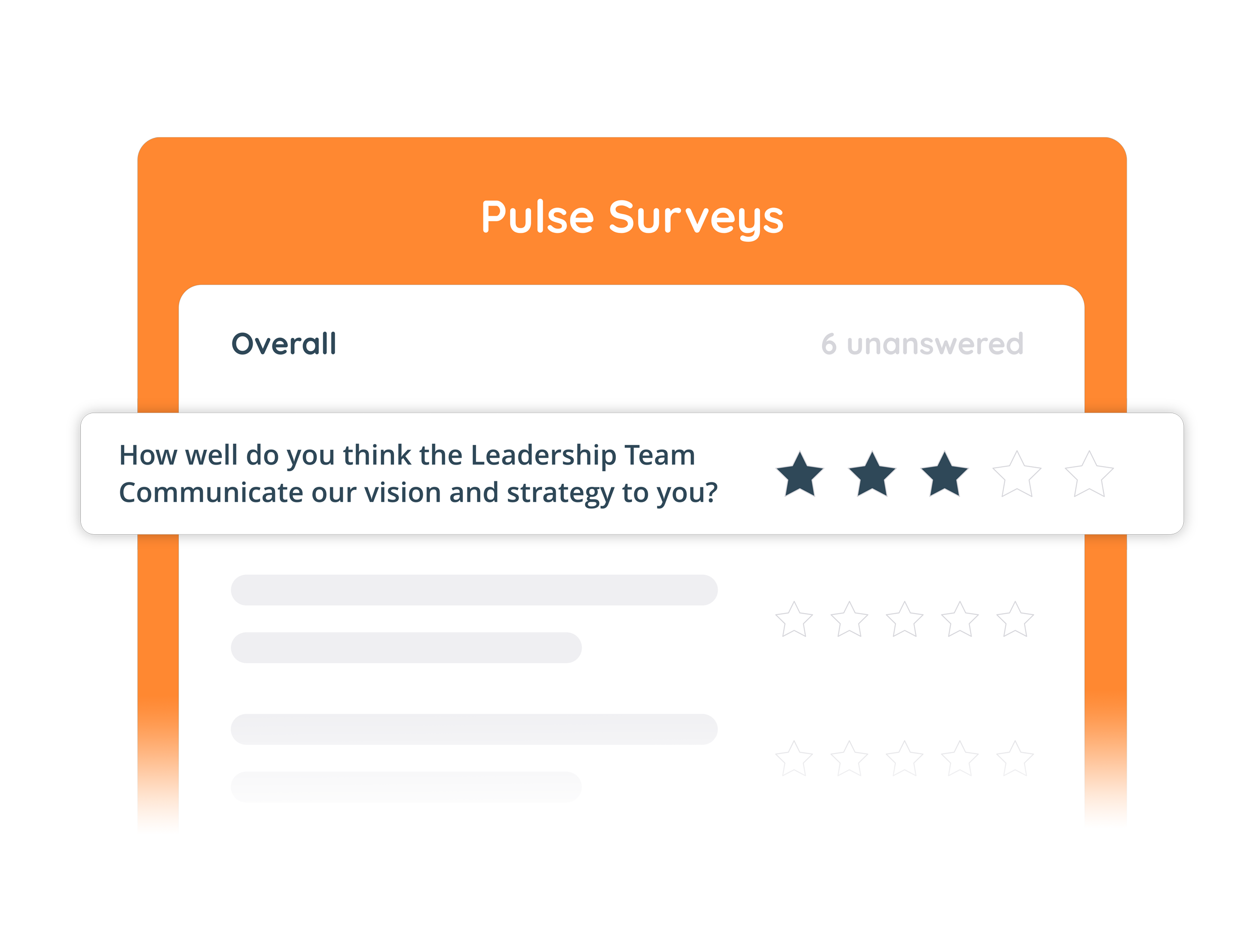
You can’t improve what you don’t measure. Make gathering feedback simple with built-in surveys, polls, and even anonymous digital suggestion boxes. This data is paramount for improving the employee experience.
Employee recognition tools
If employees feel that their work is not properly recognised, they will quickly lose engagement. Make recognition a daily habit! Tools for peer-to-peer celebration and virtual shout outs are essential for showing people they’re valued.
Idea management systems
Harness the brilliant ideas floating around your company by providing a structured, central hub for submission and collaboration.
How to use intranet software to transform internal comms (best practices)
These four principles will help you launch your intranet with high adoption rates, and keep them high too.
Strategy first: defining your channel-message matrix
Avoid the spray-and-pray approach. You need to choose the right channel for the right message. Is it an urgent push? A celebration post? A long-form policy? Be intentional about the channel to ensure your communication lands effectively.
Create a culture of contribution, starting with leadership
Your intranet shouldn't just be the leadership talking at people. Follow the wisdom of organisations that went working offline to improve online by involving your people. Crucially, senior leaders must model behaviour by actively using the intranet. Recruit and empower internal comms champions across your business to keep the content fresh, relevant, and local.
Strategic content focus: aligning comms with purpose
To drive business results, your IC must align with strategic goals. Prioritise content on the platform that drives:
-
Strategy, vision, and purpose: Connecting daily work to the 'bigger picture.'
-
Organisational change: Communicating transparently and supporting change management initiatives.
-
Values and culture: Amplifying recognition, inclusion, and what it means to work "here."
Content governance and knowledge base creation
Your credibility rests on accuracy. Establish clear content governance rules about who publishes and approves what. By standardising information and procedures into a structured knowledge base, you protect your single source of truth.
The continuous feedback loop
How to keep adoption high? By listening! Use your analytics and survey tools to establish continuous feedback loops. Ask employees what they need, what works, and what doesn't, then visibly act on that feedback.
Proving your internal communications intranet value: metrics, ROI, and future-proofing
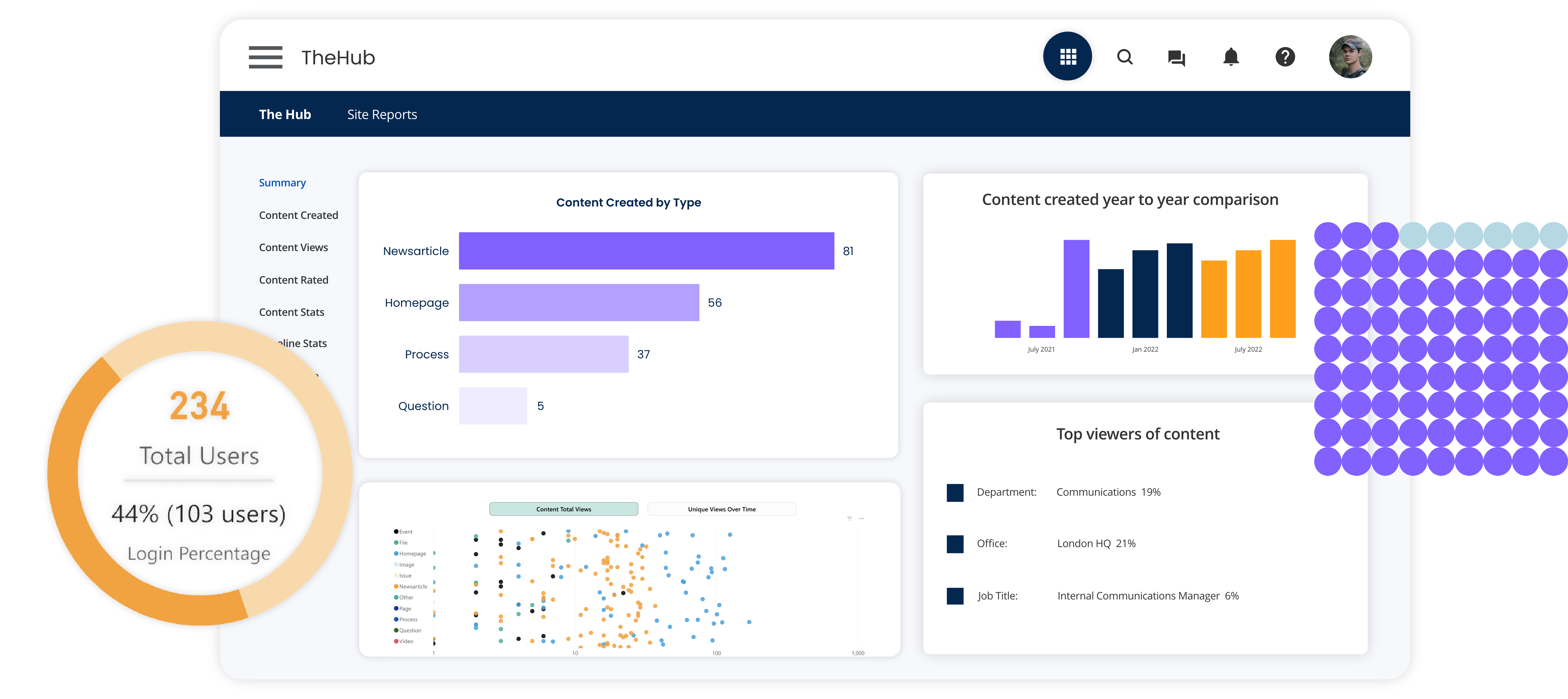
To secure budget and earn that seat at the executive table, you have to prove your impact. This section shows you how to use metrics to prove intranet ROI.
Measuring intranet adoption and reach
These numbers show you who's using the platform:
-
Login rate: Are your people checking the intranet daily?
-
Unique visitors: Are you successfully reaching your entire audience?
-
Content consumption per user: What content resonates? Use this data to strategically create more of what works!
Measuring engagement quality
True engagement is active, not passive:
-
Comment-to-view ratios: A high ratio shows your content is sparking dialogue.
-
Survey completion rates: This reflects trust and willingness to be involved.
-
Participation in social features: Activity in groups and recognition posts proves the community is thriving.
Calculating the business impact (intranet ROI)
Translate engagement into hard business metrics:
-
Productivity gains: Quantify the time saved when an employee finds a document instantly instead of spending 20 minutes searching.
-
Cost savings: Show how the intranet has reduced your reliance on expensive mass email tools or other collaboration licenses.
-
Talent correlation: Use engagement data to build a case that a connected, informed workforce leads to lower staff turnover and higher profitability (remember that 23% more profitable stat?).
The future-proof intranet: AI, automation, and trends
AI still remains a hot topic. Everyone's talking about it, but how can you actually use it in your internal comms to your advantage?
AI-powered search
One of the best things your intranet can do for your organisation is give them access to everything they need quickly, which is why AI-powered search is so useful. Not only can your employees find exactly what they need, it gives people the tools to ask questions about policies, documents and work and get immediate answers and overviews.
AI-powered personalisation
AI curated homepages and feeds give your employees the content that they want and need, reducing information overload and providing a bespoke experience when it comes to content.
Content creation assistant
As an internal communicator using AI as your personal comms assistant means it can help you make decisions based on key company information, helping you to craft content, announcements and ensures every piece of comms you create is on brand.
Selecting the right internal communications intranet platform: key evaluation criteria
Hopefully you have a good idea of how an internal communications intranet can connect your workforce and change the way you work, but intranets come in all shapes and sizes.
Top intranet platforms for internal comms
The intranet market is diverse, with providers specialising in different organisational needs. Finding the right fit requires understanding their primary focus. Here's a brief look at some of the key intranet providers and what they offer.
|
Category |
Platforms (Examples) |
Best For |
Key Differentiator |
|
Culture & Engagement Focused |
Oak Engage, Workvivo, Blink |
Organisations prioritising high employee adoption, social interaction, and a mobile-first experience (especially frontline workers). |
Feature consumer-grade UX, strong social feeds (Facebook-like), recognition tools, and easy broadcast messaging. |
|
Microsoft-Native & Enterprise |
Unily, LumApps, Happeo |
Enterprises heavily invested in Microsoft 365 or Google Workspace that need a flexible, governance-focused overlay. |
Offer deep, seamless integration with Teams, SharePoint, and Google Drive, solving issues like knowledge management for large, complex structures. |
|
Knowledge & Collaboration Focused |
Guru, Igloo, Jive |
Companies where knowledge management and sophisticated AI search are the highest priority for documentation and processes. |
They excel at creating structured knowledge bases, team collaboration spaces, and robust document management. |
|
Foundation & Customisation |
SharePoint (Native), Interact |
Large organisations with dedicated IT resources that require maximum customisation or already have legacy infrastructure in place. |
SharePoint is a powerful document management platform that acts as an intranet backbone. Interact is known for deep functionality and custom solutions in regulated industries. |
If you're looking for an in-depth evaluation of the best intranet providers in 2026, look no further:
Recommended reading: 2026 Top 10 best intranet platforms
5 Steps to implementing an internal communications intranet
1. Conduct a communication audit
Before choosing technology, identify where information is currently getting lost. Most businesses suffer from digital noise; too many emails, fragmented Slack/Teams channels, and outdated physical noticeboards.
-
The goal: Map out your current information flow. Identify which departments are disconnected and which channels are causing "notification fatigue."
-
Strategy tip: Look for a platform with in-depth analytics that can benchmark engagement by department or location before you fully migrate. This allows you to prove the value of your intranet and comms efforts by showing increased reach.
2. Establish a "single source of truth"
A common reason intranets fail is content clutter. Prioritise platforms that allow for a clear distinction between knowledge management (static) and internal comms (dynamic).
-
The goal: Create a digital library where key universal documents (handbooks, HR policies, brand guidelines) are easily searchable and separated from news (company updates, social shout-outs).
-
Strategy tip: Evaluate the CMS (Content Management System). It should be simple enough for non-technical HR or Comms managers to update without needing IT support.
3. Prioritise "mobile-first" inclusivity
For organisations with frontline and deskless workers (retail, manufacturing, healthcare), a desktop-only intranet is a major barrier.
-
The goal: Ensure 100% reach by providing access via personal or company mobile devices without requiring a complex VPN or even a corporate email address.
-
Strategy tip: Look for features like QR code provisioning for easy login and push notifications that can be targeted to specific roles or locations so employees only receive what is relevant to them.
4. Activate an "internal champions" network
A successful launch depends on buzz and excitement, which is why you need your internal champions across different departments on board, and part of your launch plan to encourage people to get involved.
The goal: Recruit early adopters to test features and seed the platform with organic content (like project wins or team photos) before the official company-wide launch, and post launch.
-
Strategy tip: Modern platforms often include social and recognition tools (likes, comments, @mentions). These features are essential for champions to create a "social proof" environment that feels like a community, not a corporate filing cabinet.
5. Build a continuous feedback loop
Having a successful launch is important, but you want your intranet to stay relevant and stand the test of time, which means your intranet must evolve based on how employees actually use it.
-
The goal: Move beyond "vanity metrics" (like total logins) and measure things like sentiment and impact.
-
Strategy tip: Instead of long annual surveys, use pulse polls, short, 1-2 question surveys embedded directly into the news feed frequently. This provides real-time data on employee sentiment and allows you to pivot your content strategy based on real-time insights.
If you’re in the stages of considering intranets, we have a great intranet requirements checklist guide with a free worksheet to help you map out your needs and requirements in the planning stages.
Bring your people together in 2026
Choosing the right internal communications intranet in 2026 can be a powerful tool in your arsenal for changing the way your workforce operates. Jo Pitchford, Engagement and Culture Lead at SCS explains it perfectly:
“It's a place where colleagues feel connected, informed, and valued, regardless of their physical location. The success of the partnership is evident in the high engagement rates, with a significant percentage of the workforce actively using the platform in such a short space of time. This launch marks the first phase of a broader plan to introduce additional tools focussed on celebrating success, product engagement, sustainability and streamlined corporate communications.”
Their intranet, designed for internal communications, helped them to connect their dispersed workforce around key information and connect easily with one another. You can read the full SCS case study here.
